
The night our Dream came true
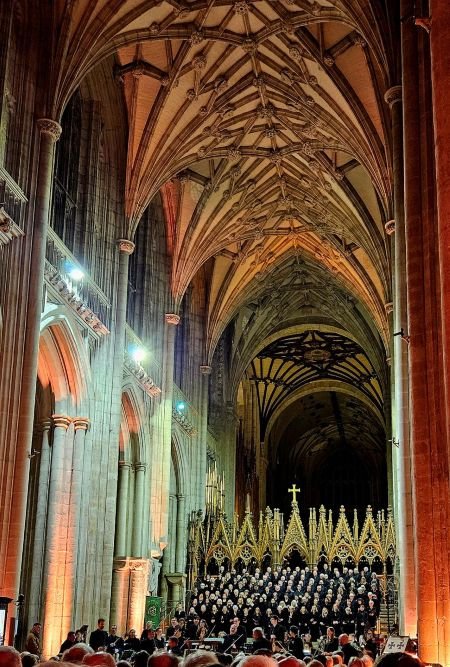
Photo credit: Sue Harvey
It is in the afternoon that the excitement always begins for us, when we first arrive at the cathedral to find the orchestra assembling and our waiting seats raked high against the towering quire screen.
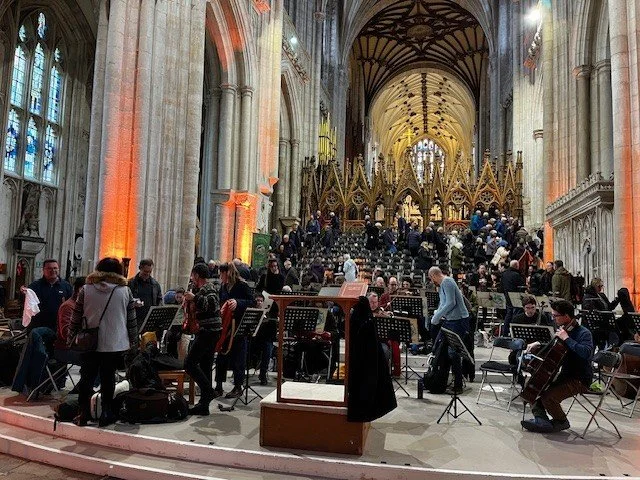
Rehearsal set-up
It’s in the afternoon, too, that we first perform for an audience. Not the paying concert-goers who will later sit in expectation and anticipation, but the Cathedral visitors who are there not to listen to music but to wander round the building. (With the odd exception of course- in this case not least our own David Reece!!)
The reactions of that passing crowd to our unintentional performances are always noteworthy, and it seemed on Friday that, as Elgar’s Prelude to his Dream of Gerontius rose almost incongruously from the casually dressed orchestra, the attention of the passing crowd was not only caught but captured. Elgar’s incredible music seemed to grasp everyone within earshot and hold both them- and us- rapt in the introduction to Elgar’s dreamscape of the afterlife. We were transported, before we had even begun, and so began what felt like a very special rehearsal.
In a rehearsal the spell is soon broken, of course, with a direction from the conductor here, the conversation of a tour group there. On this occasion it was broken twice by the Angel herself, Dame Sarah Connolly, who switched in a flash from breathtaking angel to working musician as she stopped, mid soar, to discuss tempo with Andy. And there was no doubt that this was indeed a full hardworking musicians’ rehearsal, with Andy using every last minute of rehearsal time to squeeze every last drop of perfection from all.
“The demons are sounding a little too Hampshire,” was one of his parting comments to us that afternoon, but we nodded earnestly when he said that maybe we were “saving it all for tonight”…
For while the excitement begins in the afternoon, the climax is of course the performance itself. On Friday evening the concert goers arrived, and here were the people who had come not to be unwittingly swept into Gerontius’s fever dream but who deeply desired to be taken; who wished greatly to brush against the gates of hell; to be dipped in the lake of penal waters. And in turn we the choir were longing to take them, and so for them we gave our all to become pleading souls; we became snarling demons from hell (with Hampshire a distant memory) and celestial angels, our sound enhanced and the dreamscape extended by the beautifully ethereal voices of the Chamber Choir’s semi chorus. All that had been left to do that night was to accompany Andrew Kennedy’s plaintive Gerontius by stepping boldly in to the world conjured by the ECO from the air in front of us, following the voice of the Guardian Angel herself.
We could not, however, have travelled through such other-wordly, delirious realms- in which it is almost never earthly, human voices that are required- without the guidance of one who could lead us not just as musician and man but as head-demon and seraph-whisperer. And such a leader we had that night- notably and remarkably so- in Andy. Just as he had worked hard to use every minute of our rehearsal that afternoon (and indeed, all term) he spared nothing in energy and effort on that podium as he led and inspired us to go from angelic to evil, from human to inhuman, and from peril to-finally- the beautiful peace of that final “Amen”, after the powerfully rich prayers of bass Andrew Foster-Williams.
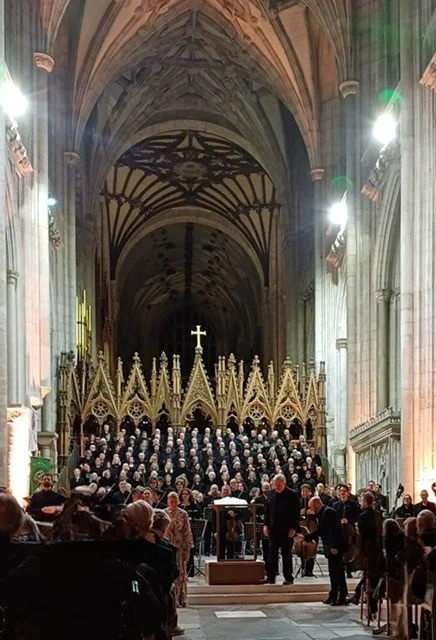
Photo credit: Chris Pankhurst
How amazing to have been part of a performance where Elgar’s Dream came so tangibly and vividly to life. A night when our Dream really did come true.
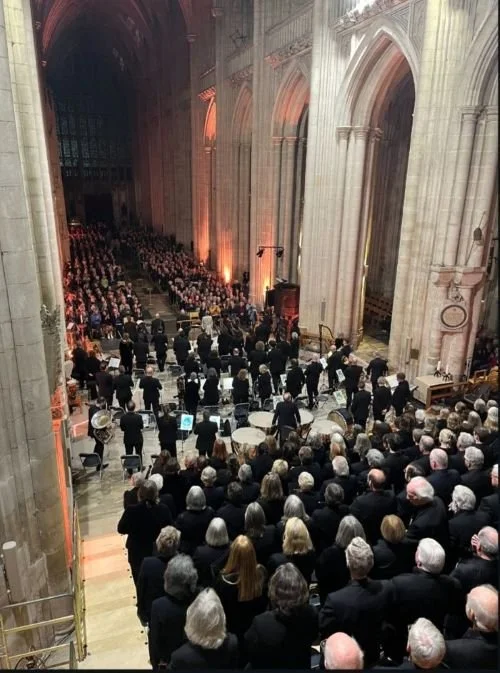
A fabulous photo taken from the organ loft by our own George Castle, whose organ playing gave such magnificent depth to our Dream
How to recover from being a demon
We now have a glorious spring break in which to unpack and recover from our big trip to the afterlife. While we will all hopefully enjoy some rest and recuperation we might also be in need of a little recreation, and to this end our B1 Roland Matthews has a suggestion for a fascinating musical day out- a visit to the Foundling Museum in Brunswick Square, London.
As the name of the museum suggests, the Foundling Museum is the only cultural institution in the UK to celebrate people who have been in care. However it is also an institution with a strong connection to music and the arts- and in particular to one George Frederick Handel, and his Hallelujah chorus especially. Indeed the museum’s history is inextricably bound with the life of of Handel and the history of the Hallelujah Chorus.
Here is Roland to tell us more…
The Foundling Hospital was founded by Thomas Coram in 1739 to care for abandoned children. There was a long tradition of prominent artists being associated with the charitable work of the Foundling Hospital, most notably William Hogarth whose magnificent portrait of Thomas Coram hangs in the museum.
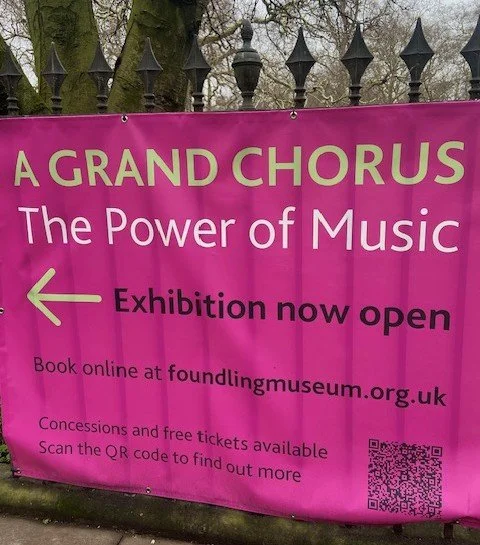
The other notable artist associated with the Hospital was Handel, and the Foundling Museum is currently celebrating this association with a special exhibition called A Grand Chorus: The Power of Music. The ‘grand chorus’ in question is of course the ‘Hallelujah Chorus’.
The exhibition, which is embedded throughout the museum’s permanent displays [the museum also houses the permanent Gerald Coke Handel exhibition]looks at Messiah’s performance history over almost three centuries and its enduring worldwide appeal and popularity. The power and benefits of singing as a collective act have been much touted in recent years, and the exhibition holds nothing back in harnessing these effects to Handel’s masterpiece.
The composition of Messiah, and its premiere in 1742, makes it an exact contemporary of Coram’s Foundling Hospital. Handel was an important early benefactor of the Hospital and became a Governor there for the final decade of his life. In 1749 he organised a benefit concert to raise funds for a hospital chapel, for which he composed the Foundling Hospital Anthem, incorporating as its closing number the ‘Hallelujah Chorus’.
So successful was this venture that the following year Handel returned to perform Messiah itself in the still unfinished chapel, and then went on to give a benefit concert of the oratorio there each year for the rest of his life.
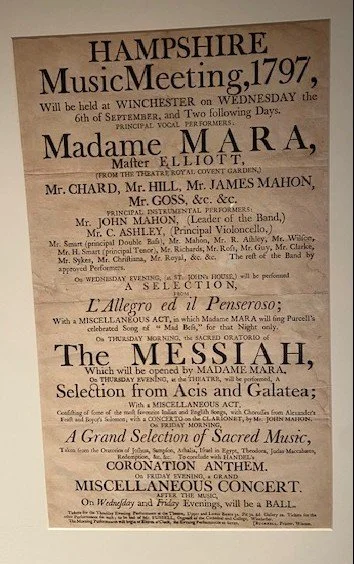
An early Winchester performance of
The Messiah (sic!)
Early material on display includes Handel’s own conducting score of the Foundling Hospital Anthem, open to show part of the ‘Hallelujah Chorus’. In his will Handel left the Hospital “a fair copy of the Score and all the Parts of my oratorio called The Messiah”. This meant that, since the work had not yet been published, the hospital could continue staging benefit performances long after Handel’s death.
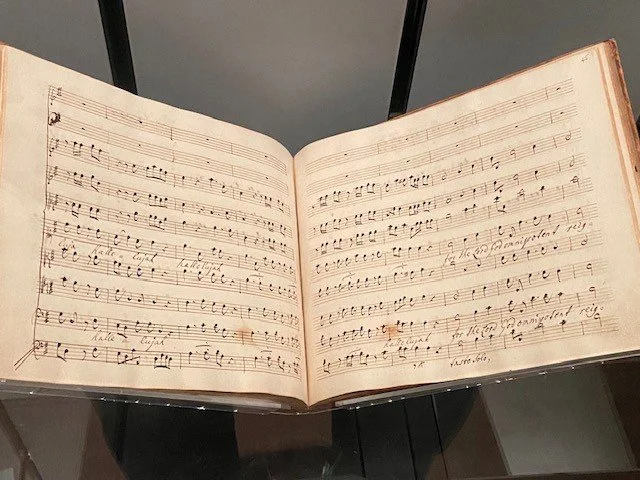
Handel’s conducting score of the Foundling Hospital Anthem, open at part of the ‘Hallelujah Chorus’, 1749
Not only did this provide a lasting source of financial support for the charity but it also made the hospital a crucial link in the early performance history of Messiah. Contrary to popular belief Messiah did not take the world instantly by storm following its Dublin premiere. In an era before large concert halls there were only a handful of performances in London during the composer’s lifetime as the subject matter was considered unsuitable for theatres and too long for church services. Handel was able, however, to bring Messiah to the chapel of the Foundling Hospital because it had not yet been dedicated for religious use and because the performance was for a charitable cause.
The exhibition features many of the weird and wonderful ways in which Messiah, and particularly its ‘grand chorus’, has been adapted to many different musical styles over the past three centuries, including Quincy Jones’ Messiah: a Soulful Celebration, a gospel album featuring such luminaries as Stevie Wonder, Chaka Khan and Gladys Knight, and “Carnival Messiah,” with a delightful rendition of the ‘Hallelujah Chorus’ by a steel band.
I warmly recommend this absorbing and entertaining exhibition which runs until the end of May.
Roland Matthews
The Foundling Museum website invites us to visit the Grand Chorus exhibition “to explore the life affirming power of music through the lens of Handel’s iconic Hallelujah Chorus.”
Doesn’t that sounds like an absolutely fantastic way to recover from being a demon?!
Happy Easter!
You can find out how to visit the Foundling Museum here and about the Grand Chorus special exhibition here
If you have something for a future Wayns Augmented blogpost then please don’t hesitate to join in the fun by sending your piece to Jacki Donnellan jacki@donnellan.org.uk or Sarah Jones